
Pride was clearly visible on Franz and Ulrich’s faces as, in the spring of 1880, they were equipped as soldiers of the Swiss Army with the newly updated “Vetterli” service rifle. At last, they carried a modern repeating rifle – precise, advanced, almost a marvel of technology. “Now we’re truly up to date,” said Franz, running his hand reverently over the stock.
But their pride quickly began to waver. The rifle was modern, yes – but, as they soon discovered, it was also remarkably maintenance-intensive. Screws had to be loosened, parts cleaned, mechanisms readjusted; and all of this having to be performed in the field, in the wind and rain.
„So ‘n Seich“, muttered Franz as he tried to loosen a screw with his pocketknife – and then slipped. „So ‘n Seich“, echoed Ulrich moments later. He had attempted to open a tin of condensed milk. His knife slipped along the metal, and a white splash poured over his uniform.
Karl, the third friend in the group, had to stifle a laugh. Yet inwardly he was just as frustrated. It could not be right that such an advanced rifle was issued without a proper tool – and that even a simple tin could become a test of patience.
Karl was a cutler by trade. In his workshop, he worked meticulously, almost pedantically. Steel was for him more than material – it was character. And a tool was only as good as its weakest spring.
Although the Swiss Army had by then commissioned a combined soldiers’ knife, the first deliveries from abroad did not truly meet expectations. They were serviceable, yes – but not precise enough, not durable enough. For a country proud of its independence, reliability, and craftsmanship, this was hard to accept.
The Army’s requirements were not complicated – but they were uncompromisingly clear: The knife must not wobble, must not jam, must not break. It had to combine a blade, screwdriver, and tin opener – and it had to work. Every time! Any failure in the field could prove disastrous.
The thought would not leave Karl. While Franz and Ulrich cleaned their uniforms, Karl pondered springs, steel hardness, and mechanics. Back in his workshop after duty, he looked at his workbench with a fresh pair of eyes.
“If there isn’t a proper one,” he murmured, “then I’ll just have to make one.”
He began to sketch. A handle that could house several tools. A construction that remained stable even when multiple layers were stacked. But he soon realised the true challenge: the spring mechanism.
Several tools in one handle meant multiple back springs – precisely aligned. Too much tension, and the knife was difficult to open. Too little, and the blade snapped back dangerously.
Karl tried, discarded, and started again. He filed steel thicknesses, tested spring tension, checked closing angles. He heated steel in the coal fire, quenched it in water, and tested its elasticity with a scrutinising eye. No part was random. Everything had a purpose – and only that. Then he thought of the soldiers in the field. Wet hands, cold fingers. The tool had to remain reliable even then.
By 1891, he finally held a version in his hands that satisfied him. No adornments, no luxury – simple scales, solid mechanics. But it worked!
With a pounding heart, Karl Elsener presented the Swiss Army with his first domestically manufactured soldiers’ knife. It was no revolutionary marvel. For the soldiers, it was not a symbol. It was a tool. And therein lay its strength. It worked. Day after day. In rain, dust, and cold. The Army was satisfied. But Karl was not entirely done.
He had realised that the same principle – several useful tools in compact form – made sense beyond the military. People were travelling more. Railways connected cities; citizens went hiking; mountaineers were scaling the Alps. Practical solutions were needed on the go. So, he began to think again – not bigger, but broader.
In 1897, he developed a refined version: two blades, one large and one small, a separate tin opener, and – for Officers and travelers – a corkscrew! The SWISS OFFICERS’s knife was born.
It was not a break from the soldiers’ knife, but a logical evolution. It remained precise, robust, and functional – yet it gained versatility. In this lay the Swiss virtues of restraint over exaggeration, quality over spectacle and progress without haste.
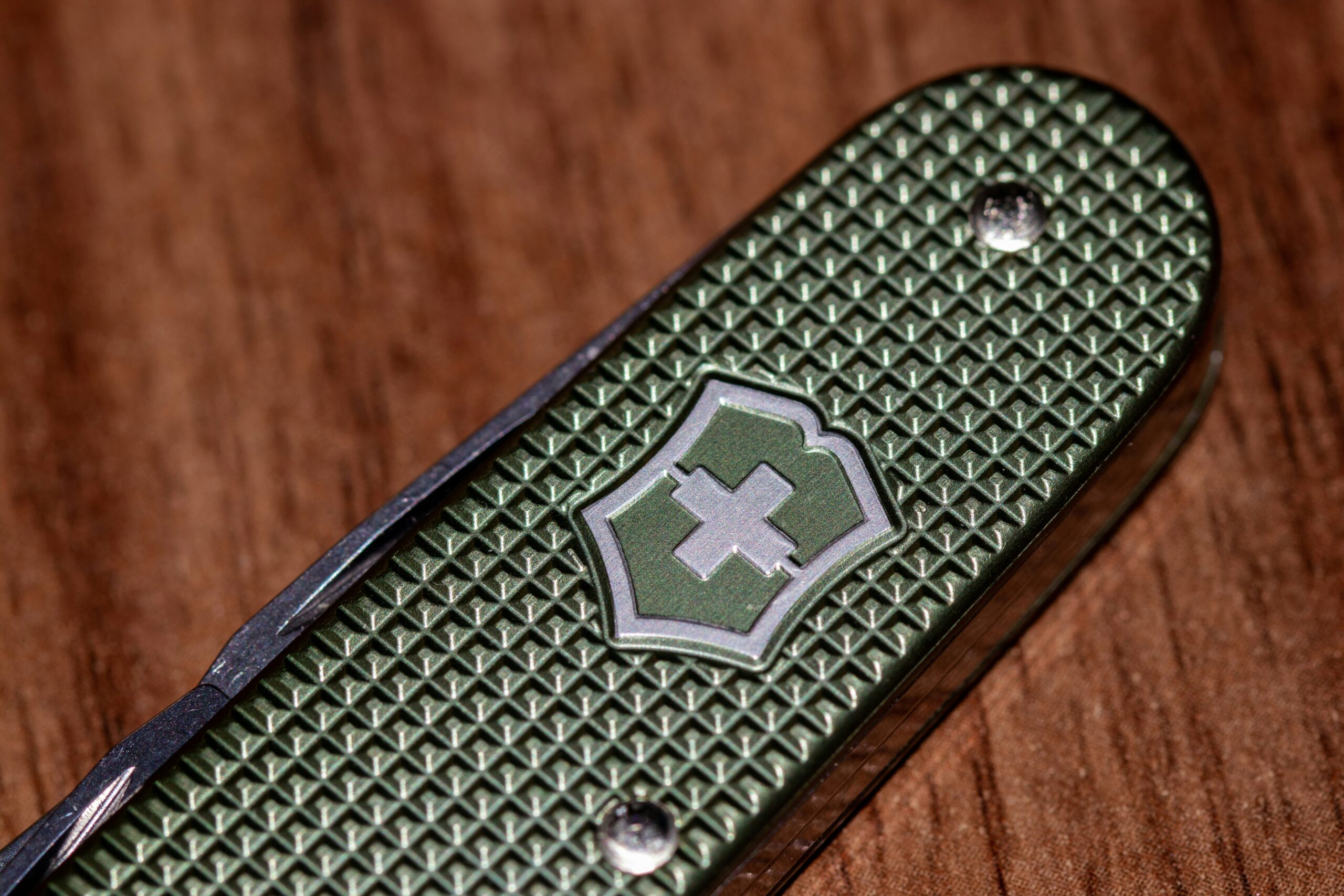
In 1909, his mother, Victoria, passed away. She had always been his steady anchor, believing in him even when the early prototypes failed. In her honour, he renamed his company “Victoria” and adopted the Swiss cross as a trademark – a visible declaration of origin and quality.
In 1921, Karl Elsener’s heirs began making knives from stainless steel (“acier inoxydable”) and combined it with their grandmother’s name: Victorinox.
The years brought challenges. Economic crises, uncertain times, scarce resources. Yet Victorinox stayed the course. No hasty experiments. No compromises on quality. Swiss steadiness instead of loud promises.
Time and again, soldiers, travelers, and even astronauts (since the 1970s, it has been part of the standard survival kit for NASA astronauts. “Never leave the planet without one,” as Chris Hadfield famously remarked in 1995.) have reached into their pockets and pulled out a small red knife — and relied on it.
Perhaps it began with a frustrated curse over a stubborn tin of condensed milk or with a troublesome screw on the Vetterli rifle. But surely, it began with a simple thought: there must be a better way to do this.
From military necessity and meticulous craftsmanship emerged a tool that would grow far beyond its original purpose. Not through noise or coincidence, but through careful design. Thoughtfully made. Quietly indispensable.
And much like a Swiss Army knife, which succeeds through precise construction, clear structure, and versatile design, sustainable business success relies on a solid foundation. A carefully built yet flexible structure is essential to safeguard assets, preserve wealth, and plan succession wisely.
With over 23 years in the fiduciary business, we at Carey Zurich know the ins and outs of suitable structures and can provide significant support in helping you achieve your goals and those of your family. We are committed to serving with Swiss quality and reliability, innovation, creativity, efficiency and trust – because we care(y).
At CAREY ZURICH, we are specialist in setting up and managing advantageous structures for our customers and we would be pleased to establish a private structure in the form of a company, trust, foundation or whatever is suitable. We are committed to serving the needs of our customers with all the Swiss thoroughness and reliability that you would expect, because we care(y).